FPR Pro SeriesUpdated 3 months ago
Product Name: FPR AN-10 AN-12 Product Description: FPR Product Number: TS-0404-10XX/11XX |
IMPORTANT NOTES ON YOUR FUEL PRESSURE REGULATOR
- Do NOT remove or adjust the collar.
- Turbosmart accepts no responsibility whatsoever for incorrect installation of this product which is potentially hazardous and can cause serious engine damage or personal injury. Ensure there are no leaks in your fuel system after installation and you have checked fuel suitability.
- Use only high-quality fittings ensuring maximum sealing reliability. Optional Turbosmart fitting kit available.
- Ensure that all plumbing is appropriately secured, is the correct size and chemical rating for your application when fitting your FPR.
- Ensure to relieve fuel pressure before removing OEM Fuel Pressure Regulator
- Your fuel pressure regulator should be mounted at least 100mm from any significant heat source.
- Gauge port is 1/8” NPT.
- All FPR's can be mounted in any direction.
RECOMMENDATIONS
- Turbosmart recommends that your fuel pressure regulator (FPR) is fitted by an appropriately qualified technician
- Turbosmart recommends that the engine Air-Fuel ratio checked once fuel pressure is set.
- Optional Turbosmart fuel rail adaptor kits: TS-0402-100X (Honda, Nissan, Toyota, Mitsubishi, Subaru, Ford, Audi and more supported)
- Optional Turbosmart fuel filter kits: TS-0402-1132 (-10 AN)
HOW TO INSTALL YOUR FUEL PRESSURE REGULATOR
TOOLS REQUIRED
Non-marking spanners to tighten fittings.
Allen Key Set
KIT CONTENTS
Please check that the following items have been provided in your FPR kit.
Quantity | Description | Use |
1 | Turbosmart FPR | Main unit |
2 | M5 Mounting Screws | Secures the mounting bracket to the main unit |
1 | Mounting Bracket | Mounting bracket used for remote mounting the FPR |
1 | Turbosmart Sticker | Turbosmart sticker |

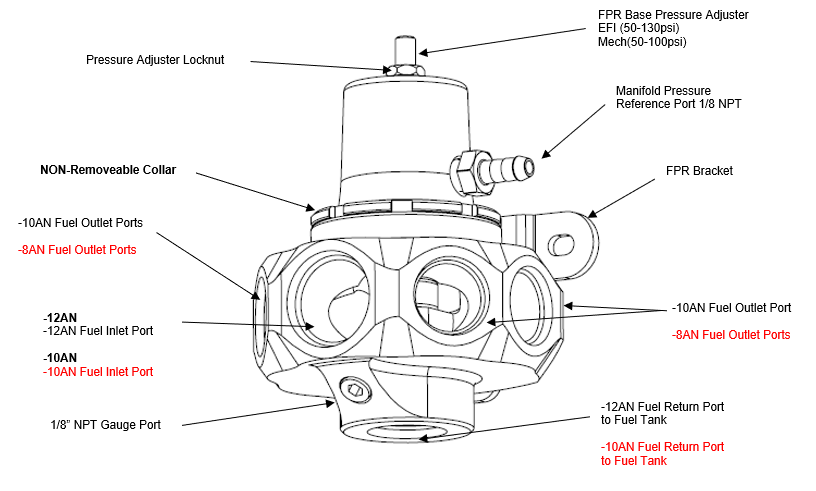
FPR OVERVIEW -12AN Pro EFI
(-10AN differences noted in Red)

FPR OVERVIEW


FITTING YOUR FPR
Locate fuel pressure feed line, base pressure and determine mounting location
This line is usually found by identifying your injectors, the fuel rail the injectors are mounted to and then the line that is feeding the fuel rail. Turbosmart recommends determining your current base fuel pressure with your existing regulator to identify a reference for the base pressure you set the new regulator to. This can be done with any reputable pressure gauge at idle and with the vacuum hose disconnected from the regulator. Take time to determine where you wish to mount the FPR in the engine bay. Some examples of placement for your FPR are:
- Mounted against chassis
- Mounted onto fuel rail
- Mounted onto intake manifold
CAUTION!
Do not place the FPR near a significant heat source as this may lead to severe engine fires.
CAUTION!
Ensure to relieve fuel pressure before removing OEM Fuel Pressure Regulator
Prepare FPR for installation
Prior to mounting the FPR, install fittings into FPR with high quality AN ORB fittings ensuring the O-Ring is present.
CAUTION!
Flare fittings CANNOT be used internally on the FPR. They must be ORB internally.
CAUTION!
O rings are not used in the FPR Kompact (1/8” NPT) due to the tapered thread. A fuel safe thread lubricant should be used.

CAUTION!
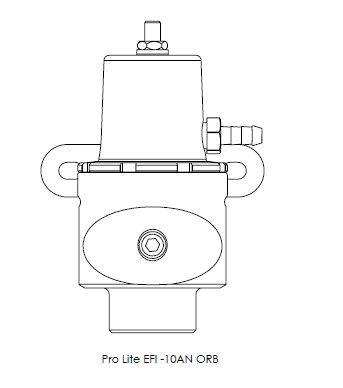
Ensure correct installation of fittings to prevent high pressure and temperature fuel leaks which can lead to extremely dangerous fires. See across for example of ORB fitting – note the O-ring.


Fit Gauge or Sensor Port (OPTIONAL)
This step is optional. Prior to mounting the FPR, install 1/8” NPT gauge or sensor. Unscrew existing 1/8” NPT blank anti-clockwise with 3/16” hex key. Apply thread lubricant and screw in clockwise until finger tight, then tighten further 1-2 turns for seal. Turbosmart gauge kit optional – TS-0402-2023.

Mounting your FPR
With all fittings installed onto the FPR, the FPR can now be mounted. The mounting bracket is held on with two M5 Allen key screws. A 3mm Allen key is required to mount these to the back of the FPR. The mounting bracket is now successfully installed, and you can now mount your FPR in your specified location. Proceed to connect your fuel lines.
Start engine and check for leaks
Congratulations, your FPR is installed and ready for use. Double check all fittings, lines and mountings then proceed to activate fuel pumps and check for leaks.
CAUTION!
Engine may run rough with incorrect base fuel pressure.
CAUTION!
If fuel leaks are present – switch off engine immediately and rectify leaks.
See over for troubleshooting steps.
CAUTION!
An incorrect setting of fuel pressure may cause your engine to run lean with the potential for detonation. Turbosmart recommends air-fuel ratios are checked immediately after base pressure adjustments.
ADJUSTING YOUR FPR
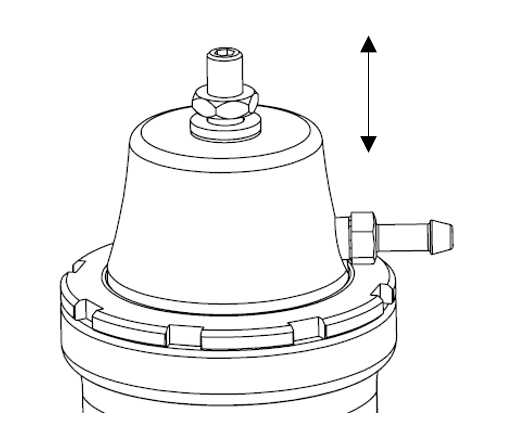
Remove signal reference hose and loosen 10mm locking nut
Remove vacuum/pressure signal reference hose from nipple and loosen 10mm locking nut on top of FPR anti-clockwise to allow for free movement of the adjuster screw.
NOTE!
Mech Pump uses a 13mm locking nut
Adjust base pressure
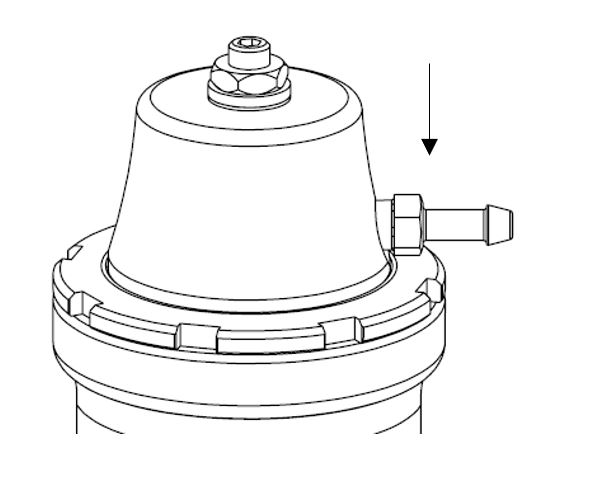
Ensure battery voltage is sufficient and idle engine. Observe the base pressure on the gauge or your data logging device, turn the adjuster with a 3mm hex tool clockwise to increase fuel pressure and anti-clockwise to decrease fuel pressure. The example below is an increase in fuel base pressure.
NOTE!
Mech Pump uses a 4mm hex
CAUTION!
Avoid screwing adjuster in forcefully as this will not allow for the device to regulate fuel pressure and can cause damage to your fuel pumps
Tighten 10mm locking nut and reconnect signal reference hose
Once base pressure has been successfully set, reconnect the signal reference hose and tighten the 10mm locking nut preventing the adjuster screw from self-adjusting. Your FPR has now been adjusted.
TROUBLE SHOOTING
- FPR Leaking – Check fittings are tight and O-Rings are present or not damaged.
- FPR regulating below 50psi (345kPa) – Ensure fuel pump pressure is above 30psi with no regulator, if fuel pressure is below 30psi, the FPR will not regulate until inlet pressure exceeds 30psi. Possible faulty fuel pump/electrical connection.
- FPR regulating above 100/130psi (690/896kPa) – Ensure fuel return line is not restricted causing a pressure build up for the regulator.
- FPR not holding base pressure – Check for blockages, leaks in the system and that fuel pumps are active.
- Failing the above, submit a technical request to [email protected] with information of your engine, fuel type and photos of installation